
Driving Theory Test Pass Calculator
Multiple-Choice Questions
Total questions: 50 | Pass mark: 43/50
Hazard Perception
Maximum points: 75 | Pass mark: 44/75
Imagine sitting in a quiet room, staring at a screen. Your heart is pounding. You have studied for weeks, but now it comes down to this: can you answer the questions correctly? The driving theory test is the first major hurdle in your journey to getting a full driver's licence. It isn't just about memorizing facts; it is about proving you understand how to stay safe on the road. Many people think the theory test is easy. They are wrong. Every year, thousands of candidates fail because they underestimate the complexity of the questions or get stuck on the tricky parts. You don't need to be a genius to pass, but you do need to know exactly what kind of questions will appear on your screen. Let’s break down every single type of question you will face so you can walk into that test center with confidence.
The Multiple-Choice Questions: More Than Just Memory
The core of the theory test consists of multiple-choice questions. In most jurisdictions, including the UK and many other countries following similar standards, you face 50 questions. You usually have about 57 minutes to complete them. That sounds like plenty of time, right? Wrong. These questions are designed to trick you.
You won’t just see simple questions like "What does a red light mean?" Instead, you will encounter scenarios. For example, a question might ask: "You are approaching a junction where the road is wet. What should you do?" The options might all seem correct, but only one is the *best* action according to official driving guidelines. This tests your judgment, not just your memory.
- Rule-based questions: These cover traffic laws, speed limits, and parking regulations. You need to know the specific numbers and distances by heart.
- Situational questions: These present a driving scenario and ask for the safest course of action. Think about defensive driving here.
- Sign recognition: You will see images of road signs and must identify their meaning instantly.
To pass, you typically need to score 43 out of 50. That means you can only miss seven questions. If you guess randomly, you will fail. You need a strategy. Read each question carefully. Look for keywords like "always," "never," or "first." Often, the correct answer is the one that prioritizes safety above all else.
Hazard Perception: Reading the Road
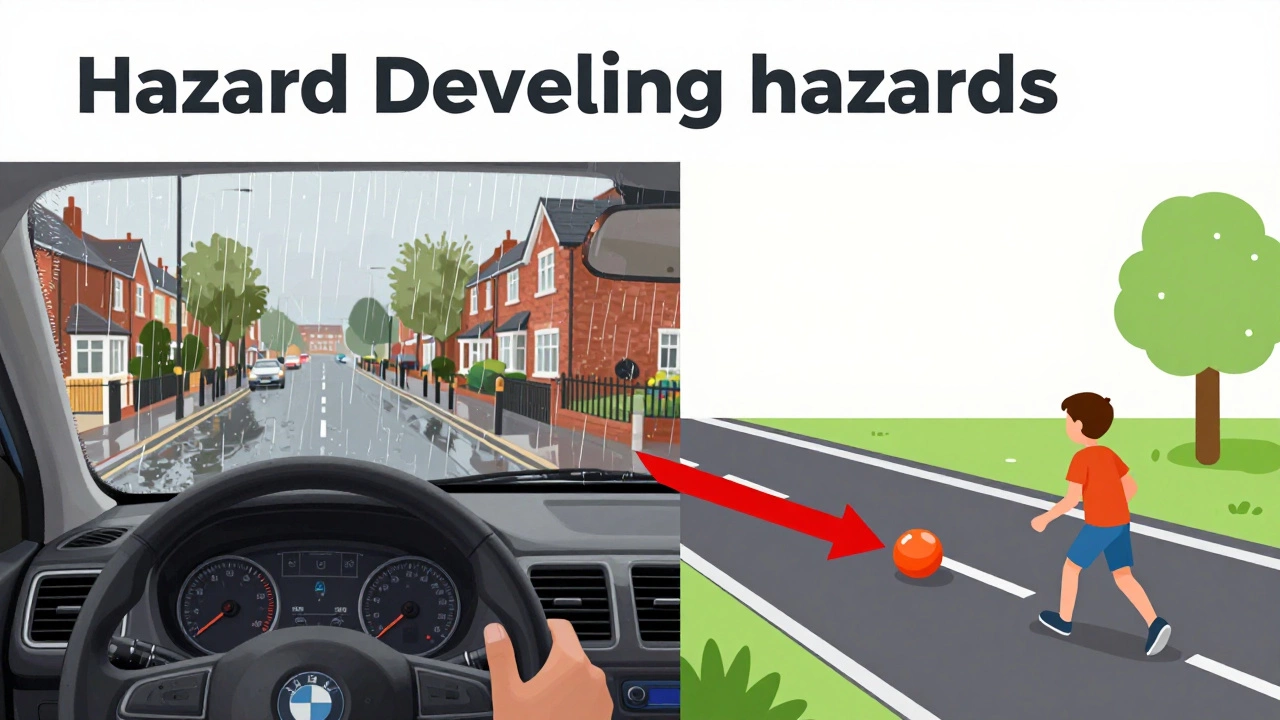
If multiple-choice questions test your brain, hazard perception tests your eyes and instincts. This part of the test involves watching video clips of real driving situations. Your job is to click the mouse as soon as you spot a developing hazard.
A hazard is anything that requires you to change your speed or direction. It could be a ball rolling into the street, a car pulling out from a side road, or pedestrians crossing unexpectedly. The key word here is "developing." You shouldn’t click when you first see a stationary object. You click when the situation starts to become dangerous.
| Action | Points Awarded |
|---|---|
| Click too early (before hazard develops) | 0 points |
| Click very early | 1 point |
| Click moderately early | 2 points |
| Click on time | 3-4 points |
| Click late | 0-1 points | d>
There are usually 15 clips, with some containing two hazards. The maximum score is 75 points. You need 44 points to pass. Don’t rush. Watching the clip calmly helps you react faster. Focus on the edges of the road, intersections, and areas where visibility is poor. Practice makes perfect here. Use official practice software to train your reaction time before the actual test.
Road Signs and Markings: The Language of the Road
Road signs are universal language for drivers. If you don’t speak the language, you’re lost. The theory test includes a significant number of questions related to road signs and markings. These fall into three main categories: regulatory, warning, and informational.
Regulatory signs tell you what you must or must not do. Speed limit circles, no-entry signs, and stop signs fall into this group. Ignoring these can lead to fines or accidents. Warning signs alert you to potential dangers ahead, such as sharp bends, pedestrian crossings, or slippery roads. Informational signs provide helpful details, like directions to towns, distances, or rest areas.
Don’t just memorize the shape and color. Understand the context. For instance, why is there a "School Ahead" sign? Because children might cross unpredictably. Why is there a "Slippery When Wet" sign? Because braking distance increases dramatically on wet surfaces. Linking the sign to the reason behind it helps you remember it under pressure.
Common Traps and How to Avoid Them
Test makers love traps. They design questions to catch people who skim read or rely on assumptions. Here are the most common pitfalls and how to dodge them.
- The "Best" Answer Trap: Sometimes, two answers look correct. One is good, but the other is safer or more legal. Always choose the option that minimizes risk. For example, if asked what to do when a police officer signals you to go against a red light, you follow the officer, not the light. But if the question doesn’t mention an officer, stick to the light.
- Distraction Questions: Some questions include irrelevant details to confuse you. Ignore the fluff. Focus on the core issue. If a question describes a beautiful sunny day but asks about headlight usage at night, the weather description is irrelevant.
- Double Negatives: Watch out for phrases like "Which of the following is NOT illegal?" Reading quickly can flip your understanding. Underline the negative words in your mind before choosing an answer.
Another trap is overconfidence. Many learners breeze through the first few questions and start rushing. Slow down. Each question counts equally. There is no penalty for taking extra time to think. If you get stuck, mark the question and move on. Come back to it later if time permits.

Preparing Effectively: Beyond Memorization
Cramming the night before won’t work. The theory test requires deep understanding. Start studying at least four weeks before your test date. Use official study materials. The Highway Code (or equivalent manual) is your bible. Read it cover to cover. Then, take practice tests online.
Practice tests simulate the real experience. They help you get used to the format, timing, and types of questions. Aim to score consistently above 45/50 in practice. If you keep failing certain topics, like motorway rules or emergency procedures, focus extra time on those areas.
Also, talk to experienced drivers. Ask them about their worst mistakes or closest calls. Real-world stories make the rules stick. For example, hearing a friend describe a near-miss at a roundabout makes the "give way to traffic from the right" rule much more memorable than just reading it in a book.
Day of the Test: Staying Calm
Your preparation ends when you sit down for the test. Now, it’s about mental state. Anxiety clouds judgment. Breathe deeply. Remind yourself that you’ve prepared well. Treat the test like a puzzle, not a threat.
Read every question twice. Check the hazard perception clips carefully. Don’t let one bad question ruin your focus. If you miss a question, shake it off immediately. Concentrate on the next one. Confidence comes from competence. Trust your training.
Remember, the goal isn’t just to pass the test. It’s to become a safe, responsible driver. The questions exist to protect you and others on the road. Embrace that mindset, and you’ll find the answers come naturally.
How many questions are in the driving theory test?
In most standard tests, such as the UK theory test, there are 50 multiple-choice questions. You also complete a separate hazard perception section with 15 video clips. The exact number can vary slightly depending on your country, so always check local guidelines.
What is the passing score for the theory test?
For the multiple-choice section, you typically need 43 out of 50 correct answers. For hazard perception, you need 44 out of 75 points. Failing either part means you fail the entire test.
Can I bring notes into the theory test?
No, you cannot bring any study materials, books, or notes into the test room. You must rely entirely on your memory and understanding. Only allowed items are usually identification documents and sometimes glasses or contact lenses.
How long does the theory test take?
The multiple-choice section allows up to 57 minutes for 50 questions. The hazard perception section takes about 20 minutes. Total time spent in the test center, including registration and breaks, is roughly 90 minutes.
What happens if I fail the theory test?
If you fail, you must wait a specified period before retaking it, often 24 hours or more. You will need to pay the fee again. Analyze your weak areas using the feedback provided and study those topics intensively before your next attempt.