
HGV Driver Daily Schedule Planner
Shift Parameters
Projected Day Timeline
| Phase | Time Window | Notes |
|---|---|---|
| Waiting for calculation... | ||
Imagine waking up at 4:30 AM in the middle of winter. The air is biting cold, but your body knows exactly what to do. You grab your high-visibility jacket, check your phone for route updates, and head to the depot. This isn't a hypothetical scenario; it is the standard reality for thousands of professional drivers across the UK. If you are considering HGV driving training, understanding the daily grind is just as important as knowing how to reverse around cones.
The "average" day varies wildly depending on whether you drive Class 1 (articulated) or Class 2 (rigid), local or long-haul, and for a courier firm or a construction company. However, there is a structural backbone that holds most routes together, driven by strict legal regulations known as Driver Hours Rules. These rules exist to prevent fatigue, which remains one of the leading causes of serious road accidents involving large vehicles.
The Legal Framework: Your Daily Clock
Before we look at the human side of the job, we need to understand the machine that governs your time. In the UK, the Driver and Vehicle Standards Agency (DVSA) enforces specific limits on how much time you can spend behind the wheel. For most HGV drivers, the maximum driving time is 9 hours per day, extendable to 10 hours twice a week. But driving time is only half the story. You also have a maximum workday limit of 11 hours, extendable to 12 hours twice a week.
This means if you start work at 6:00 AM, you cannot finish until at least 5:00 PM, even if you haven't hit your driving limit. Breaks are non-negotiable. After 4.5 hours of driving, you must take a 45-minute break. Many drivers split this into two 15-minute breaks to keep their energy levels stable. Once you complete a full shift, you are entitled to a minimum of 11 consecutive hours of rest before starting again. This is why some drivers find themselves off duty for nearly 24 hours after a long haul.
| Activity | Standard Limit | Extended Limit (Max 2x/week) |
|---|---|---|
| Daily Driving Time | 9 hours | 10 hours |
| Daily Work Time | 11 hours | 12 hours |
| Weekly Driving Time | 56 hours | N/A |
| Break Requirement | 45 mins after 4.5 hrs driving | Can be split into 15+30 mins |
| Daily Rest Period | 11 consecutive hours | Reduced to 9 hrs max 3x/week |
A Typical Long-Haul Day: The 4 AM Start
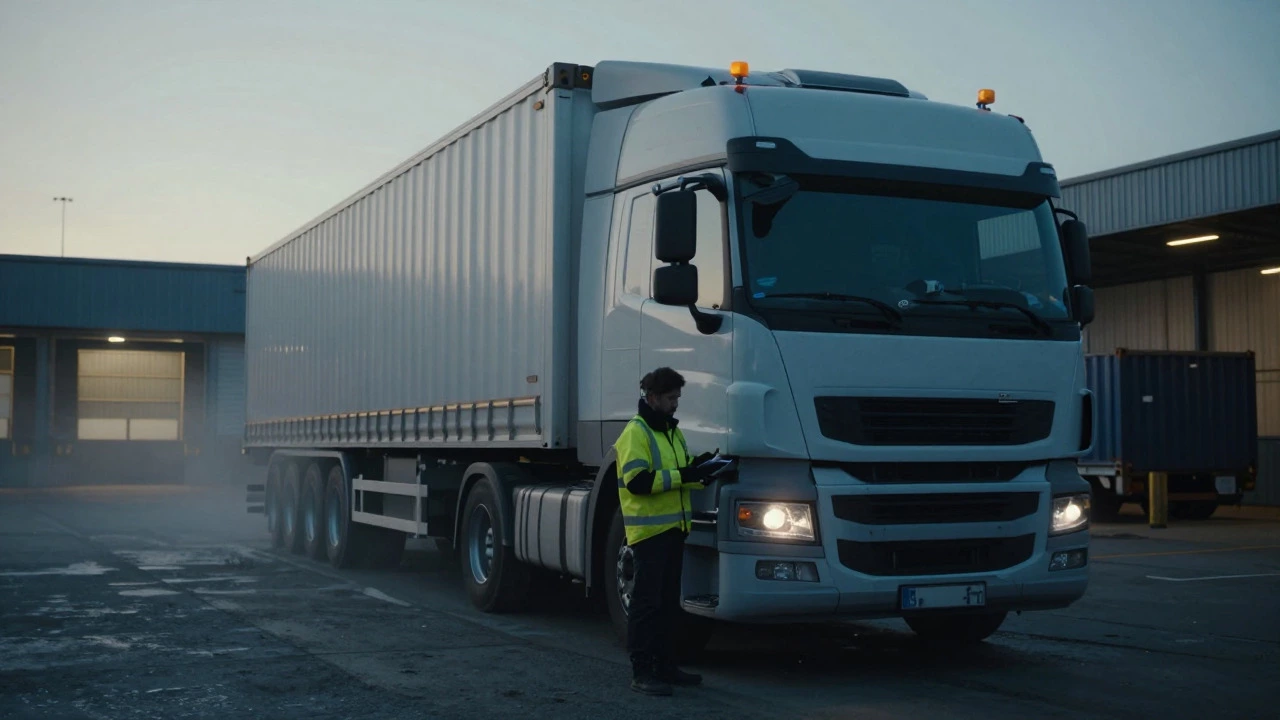
Let's walk through a realistic Tuesday for a Class 1 driver working for a national logistics provider based in the Midlands. The alarm goes off at 3:45 AM. By 4:30 AM, you are at the depot. The first hour is rarely spent driving. It involves pre-trip inspections. You walk around the tractor unit, checking tire pressures, oil levels, brake lines, and ensuring all lights function. This is a legal requirement under the Vehicle Inspection Regulations, and failing it can lead to fines or disqualification from driving that specific vehicle.
At 5:30 AM, you load the trailer. Depending on the cargo, this might involve operating a forklift or coordinating with dock workers. By 6:15 AM, you are on the motorway. The next six to seven hours are pure driving. You navigate traffic, manage fuel stops (usually once mid-route), and monitor your tachograph. The tachograph records your speed, distance, and driving status automatically. Modern digital tachographs connect to satellite systems, allowing dispatchers to track your location in real-time. This transparency means you can't hide in a layby for an extra coffee without it showing up on the screen back at base.
Around 1:00 PM, you arrive at the destination hub. Unloading takes another hour. Then comes the paperwork. In the age of electronic delivery notes, this is faster than the paper-based days of the past, but you still need to verify quantities and signatures. You leave the site at 2:30 PM. Now, you have two choices: return to the depot or wait for a return load. Most companies prefer you to return to secure the vehicle, adding another 3-4 hours of driving. You arrive home or at the depot around 6:00 PM. You log your rest period, and you are legally off duty until at least 5:00 AM the next day.
Local Distribution vs. Long-Haul: A Different Beast
If you think long-haul is the hardest part, try doing 40 deliveries in a city center within 8 hours. Local distribution drivers, often operating Class 2 rigid trucks, face a completely different set of challenges. Their days are less about highway cruising and more about urban navigation, frequent stops, and physical labor.
A typical local driver starts at 7:00 AM. They might make 20 to 30 drops between 8:00 AM and 4:00 PM. Each stop involves reversing into tight spaces, using pallet jacks or hand trucks to move goods, and dealing with customers who are often impatient. The mental fatigue here is significant. You are constantly scanning for pedestrians, cyclists, and narrow streets, rather than maintaining a steady speed on a motorway. Because they don't cover massive distances, local drivers often finish earlier, perhaps by 5:00 PM, but their shifts are punctuated by high-intensity bursts of activity rather than sustained focus.

Physical and Mental Demands
Being an HGV driver is not a sedentary desk job. It is physically demanding. You spend 10 to 12 hours sitting in a cabin that vibrates continuously. This constant vibration can lead to lower back pain, a common complaint among professional drivers. To combat this, many drivers invest in ergonomic seat cushions or perform stretching exercises during their mandatory breaks. Hydration is critical, especially in summer when the cab temperature can soar despite the air conditioning.
Mentally, the job requires high situational awareness. You are responsible for a vehicle that weighs up to 44 tonnes. Stopping distances are significantly longer than a car's, requiring you to anticipate hazards further ahead. Weather conditions play a huge role. Rain, fog, and ice require immediate adjustments to speed and following distance. For new drivers, the transition from a small car to a multi-tonne articulated lorry is a major psychological hurdle. The width of the vehicle makes roundabouts and junctions feel claustrophobic until muscle memory kicks in.
Earnings and Lifestyle Factors
Why do people endure the early mornings and long hours? The pay. Entry-level HGV drivers in the UK typically earn between £22,000 and £28,000 annually. Experienced drivers, especially those willing to do long-haul or specialized loads like hazardous materials, can push their earnings past £35,000. Some niche sectors, like airport logistics or pharmaceutical transport, offer higher rates due to the precision required.
However, the lifestyle trade-off is real. Long-haul drivers often spend nights away from home, sleeping in hotel rooms or cabs. This can strain personal relationships. That said, some drivers love the independence. There is no boss hovering over your shoulder while you drive. As long as you meet your deadlines and follow the rules, you are in control of your environment. Many drivers report feeling a sense of freedom on the open road that they didn't experience in previous office jobs.

Preparing for the Reality: Training Tips
If you are taking HGV driving training a structured course to obtain a Category C or C+E license, pay attention to the practical aspects beyond just passing the test. Ask your instructor about the realities of pre-trip checks. How long does it actually take to inspect a fully loaded trailer? Practice your reversing maneuvers in various weather conditions if possible. Familiarize yourself with digital tachographs, as manual ones are becoming obsolete. Understanding how to log your breaks correctly prevents costly administrative errors later.
Also, consider your physical fitness. Before you start, ensure you have good core strength and flexibility. Joining a gym or doing regular yoga can make a significant difference in how your body handles the daily vibrations. Finally, build a network. Connect with other drivers online or at depots. Sharing tips on fuel-efficient routes, safe laybys, and reliable meal stops can save you time and stress on the road.
Frequently Asked Questions
How many hours does an HGV driver work per week?
On average, HGV drivers work between 40 and 48 hours per week. While the legal maximum driving time is 56 hours per week, most employers aim for a 40-hour contract to avoid overtime costs and reduce fatigue risks. Overtime is common during peak seasons like Christmas or harvest time.
Do HGV drivers get paid for waiting time?
Yes, but it depends on the employer. Waiting time usually counts towards your total working hours but may be paid at a lower rate than driving time. If you are waiting for a load at a depot, you are typically paid. If you are stranded due to a breakdown, you may receive standby pay. Always clarify this in your contract before accepting a job.
Is it hard to get an HGV job without experience?
It is challenging but possible. Many large logistics companies run graduate schemes or entry-level programs specifically for new drivers. Look for roles labeled "Trainee Driver" or "Entry Level." Gaining experience in smaller, local firms can also provide a stepping stone to larger carriers. Building a clean driving record and completing additional certifications like Key Driver Qualification (KQS) can improve your chances.
What is the difference between Class 1 and Class 2 HGV licenses?
A Class 1 (Category C+E) license allows you to drive articulated lorries, where the tractor unit pulls a separate trailer. This is the standard for long-haul freight. A Class 2 (Category C) license allows you to drive rigid trucks, where the engine and cargo area are on the same chassis. Class 2 is more common for local distribution, waste collection, and construction sites.
Can I drive an HGV abroad with a UK license?
Generally, yes, but rules vary by country. Within the EU, UK licenses are recognized, but you must adhere to the host country's specific driving hour regulations, which may differ slightly from UK rules. Outside the EU, you may need an International Driving Permit (IDP) in addition to your UK license. Always check the specific requirements of the countries you plan to visit before crossing borders.