

Roundabout Priority Simulator
Select a Scenario
Choose a common roundabout situation to see how the 12 o'clock rule applies.
Ready to Simulate
Select a scenario and click simulate to see if you should give way or proceed based on the 12 o'clock rule.
You are sitting in your car, waiting to enter a busy junction. The traffic is flowing fast, and you feel that familiar knot of anxiety in your stomach. You know you need to give way, but exactly when? This is where the 12 o'clock rule comes in. It is not just a catchy phrase; it is the golden standard for navigating roundabouts safely and efficiently.
If you are preparing for your driving test or just want to drive with more confidence, understanding this concept is non-negotiable. It simplifies a complex situation into a single, visual checkpoint. But what does it actually mean, and why do instructors swear by it?
The Clock Face Concept Explained
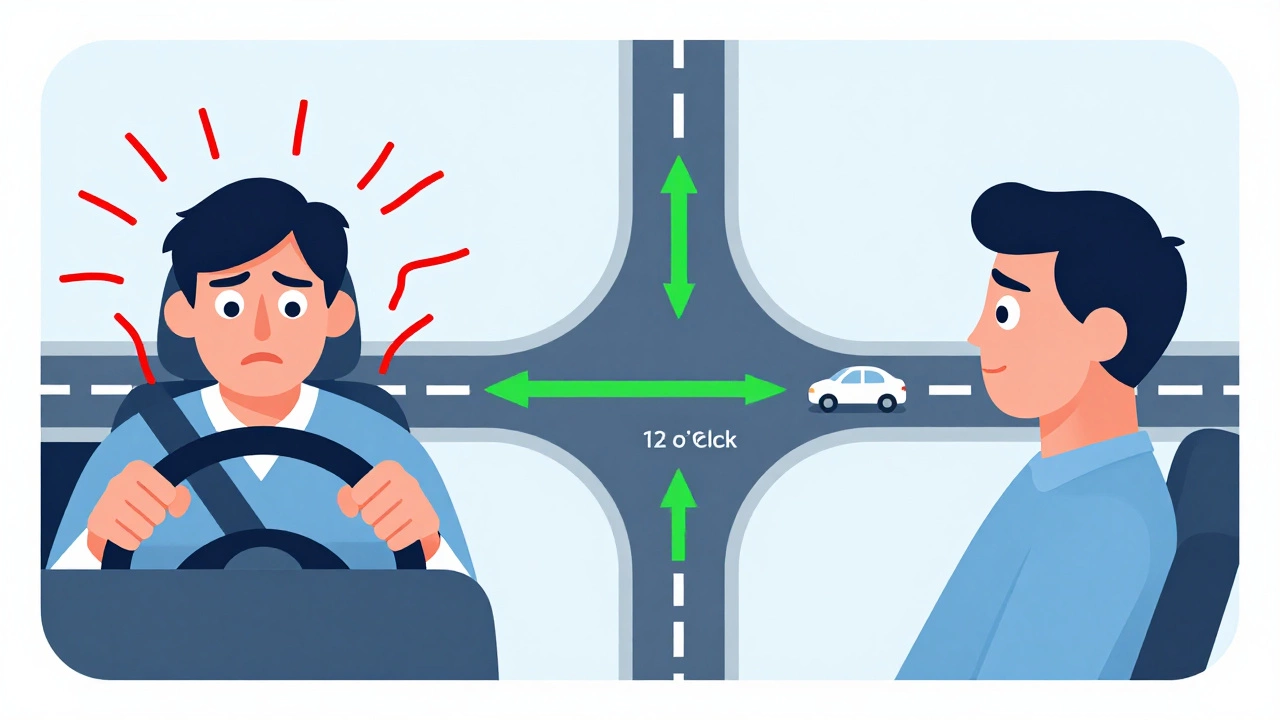
Imagine your car is the center of a clock face. When you approach a roundabout, you are looking at other vehicles as if they are hands on that clock. The "12 o'clock" position refers to the point directly ahead of you, relative to the roundabout's center.
In practical terms, the rule states: Give way to any vehicle that has already passed the 12 o'clock position relative to your entry point.
This means if a car is approaching from your left (say, at the 9 o'clock position) and has not yet reached the top of the roundabout (12 o'clock), you generally have the right of way-provided no one else is closer. However, if a car is coming from your right (3 o'clock) and is already past the halfway point towards you, it is effectively at the 12 o'clock position or beyond. That car has priority.
This mental model removes the guesswork. Instead of calculating speed and distance frantically, you simply check the "clock." Is the threat at 12? If yes, wait. If no, proceed with caution.
Why the 12 O'Clock Rule Matters for Your Driving Test
During a driving test, examiners look for two main things: safety and smoothness. Failing to give way is an immediate danger, often resulting in a major fault. Conversely, hesitating unnecessarily when you have the right of way can be marked as a lack of observation or poor judgment, leading to a minor fault.
The 12 o'clock rule helps you strike the perfect balance. It teaches you to:
- Identify priority clearly: You stop guessing who goes first.
- Reduce hesitation: Once you see the path is clear past 12 o'clock, you move confidently.
- Prevent accidents: By respecting the established flow of traffic, you avoid collisions at the entry points.
Examiners appreciate candidates who demonstrate a systematic approach to hazards. Using the clock method shows you are organized and aware, rather than reactive and panicked.
Applying the Rule in Real-World Scenarios
Let’s break down how this works in different common situations you will encounter on the road.
Scenario 1: Entering from a Single Lane
You are approaching a mini-roundabout or a standard roundabout. A car is approaching from your right. As it enters the roundabout, it passes the imaginary line drawn across the entrance opposite you. That is the 12 o'clock mark. If it is there, you must wait. If it is still far back at the 4 o'clock position, you may proceed, but always keep checking.
Scenario 2: The Multi-Lane Challenge
Multi-lane roundabouts are trickier because vehicles can be moving faster and from multiple angles. Here, the 12 o'clock rule applies to each lane independently. You must give way to vehicles in the inner lanes that have already passed the 12 o'clock position relative to your entry. Do not assume a car in the outer lane is slower; respect its momentum once it crosses that threshold.
Scenario 3: Exiting the Roundabout
The rule doesn't just apply when entering. When exiting, you must also be aware of cyclists or pedestrians who might be crossing your exit path. While the 12 o'clock rule primarily governs vehicle-to-vehicle interaction, the same principle of "checking the critical point" applies. Ensure the path ahead (your new 12 o'clock) is clear before steering out.
Common Mistakes Drivers Make
Even experienced drivers sometimes get this wrong. Here are the pitfalls to avoid:
- Ignoring the "Already On" factor: Some drivers think they only need to worry about cars currently at the junction. Remember, a car already circulating has priority over anyone entering, regardless of where they entered.
- Misjudging Speed: A car might be at the 10 o'clock position but moving very fast. It will reach 12 o'clock before you can enter. Always assess speed, not just position.
- Blocking the Entry: Never pull onto the roundabout if you cannot clear the exit. This traps you in the middle, causing congestion and potential rear-end collisions. The 12 o'clock rule helps you decide when to go, but your exit strategy determines if you should.
How to Practice the 12 O'Clock Rule
You don't need a simulator to practice this. You can start observing it today as a passenger or even while walking near safe intersections.
- Visualize the Clock: Next time you are stuck in traffic behind a roundabout, draw the clock face in your mind. Identify where each car is relative to the center.
- Predict Movements: Guess which car will pass 12 o'clock next. Watch to see if your prediction was correct.
- Drive Slowly at First: When practicing with an instructor, ask them to help you identify the 12 o'clock point verbally. "Car at 10, car at 12, now go." This reinforces the habit.
Consistency is key. Over time, this visualization becomes automatic, allowing you to focus on other aspects of driving like signaling and positioning.

Relationship Between the 12 O'Clock Rule and the Highway Code
While the "12 o'clock rule" is not explicitly named in the UK Highway Code, it perfectly aligns with Rule 185, which states that you must give way to traffic coming from your right. The clock method is simply a practical tool to interpret this legal requirement in real-time.
It bridges the gap between static text and dynamic reality. The law says "give way to the right." The 12 o'clock rule tells you *when* that vehicle from the right has become an immediate conflict that requires stopping.
| Concept | Description | Application |
|---|---|---|
| Giving Way to Right | Legal requirement to yield to traffic from the right-hand side. | General rule for all uncontrolled junctions and roundabouts. |
| 12 O'Clock Rule | Practical technique to determine if a vehicle from the right has priority. | Specifically useful for judging timing and distance at roundabouts. |
| Circulating Traffic Priority | Vehicles already on the roundabout have right of way over entrants. | Applies to all entries, regardless of direction. |
Tips for Nervous Drivers
If roundabouts make you nervous, remember that most other drivers are also cautious. Eye contact can be helpful, but don't rely on it solely. Stick to the 12 o'clock rule. If you are unsure, wait. It is better to be late than to be involved in an accident. Confidence comes from competence, and competence comes from repeated application of these simple rules.
Also, remember to signal correctly. Signal right when passing your intended exit, then signal left when leaving. This communicates your intentions to others, making their job easier and yours safer.
Is the 12 o'clock rule official law?
No, the term "12 o'clock rule" is not found in the legislation itself. It is a teaching aid used by driving instructors to help students understand and apply Rule 185 of the Highway Code, which mandates giving way to traffic from the right.
What if a car is at 12 o'clock but moving very slowly?
If a vehicle is at the 12 o'clock position, it generally has priority. However, if it is moving extremely slowly or stopping, you may proceed with extreme caution, ensuring you do not cut them off. Always prioritize safety over strict adherence to timing if a hazard presents itself.
Does this rule apply to mini-roundabouts?
Yes. Mini-roundabouts follow the same principles as larger ones. You must give way to traffic from the right. The 12 o'clock visualization works equally well here, helping you judge whether the opposing vehicle has entered the central area.
Can I use this rule in countries that drive on the left?
The 12 o'clock rule is specifically designed for left-hand traffic systems like the UK, Australia, and Japan. In right-hand traffic countries (like the US or Germany), the priority is usually from the right, so the "clock" orientation would need to be adjusted mentally to account for the different flow of traffic.
What should I do if two cars arrive at the 12 o'clock position simultaneously?
This is rare, but if it happens, defensive driving suggests yielding. It is safer to let the other driver go than to risk a collision. Clear communication through indicators and eye contact can also help resolve such ambiguous situations.