

Quick Wins for Your First Attempt
- Focus on the Highway Code: This is the foundation of every question.
- Master Hazard Perception: This is where most people lose points due to timing.
- Spaced Repetition: Study in short bursts over two weeks rather than a 10-hour marathon.
- Take Full Mock Exams: Get used to the pressure of the timer and the format.
Understanding the Test Structure
Before you open a book, you need to know what you're up against. The driving theory test is a two-part examination consisting of a multiple-choice theory section and a hazard perception clip-based test. To pass, you need to hit a specific score in both parts. If you fail one, you have to retake that specific section, but you can't take your practical driving test until both are cleared.
The first part is the multiple-choice section. You'll face 50 questions from a massive bank, covering everything from road signs to vehicle maintenance. You have 57 minutes, which is plenty of time if you know the material, but can feel tight if you're second-guessing every answer. The second part, Hazard Perception, is a test where you watch 14 video clips and click when you see a developing hazard. It's designed to test your anticipation, not just your reaction speed.
Cracking the Multiple Choice Section
The biggest mistake learners make is reading the Highway Code once and hoping for the best. The Highway Code is the official set of rules and guidelines for all road users in the UK. You don't need to memorize it word-for-word, but you do need to understand the logic of the laws.
Instead of just reading, use a driving theory test app that uses spaced repetition. This means the app tracks which questions you get wrong and shows them to you more often. If you keep missing questions about "stopping distances" or "towing a trailer," the app will hammer those home until they're second nature. A pro tip: read the question twice. Often, the DVSA (Driver and Vehicle Standards Agency) will use words like "NOT" or "LEAST likely," which can trick you into picking the wrong answer if you're rushing.
| Method | Pros | Cons | Effectiveness |
|---|---|---|---|
| Passive Reading | Easy to start | Low retention, boring | Low |
| Flashcards | Great for signs/facts | Time consuming to make | Medium |
| Mock Exam Apps | Simulates real environment | Can lead to rote memorization | High |
| Active Recall/Teaching | Deep understanding | Requires a partner | Very High |
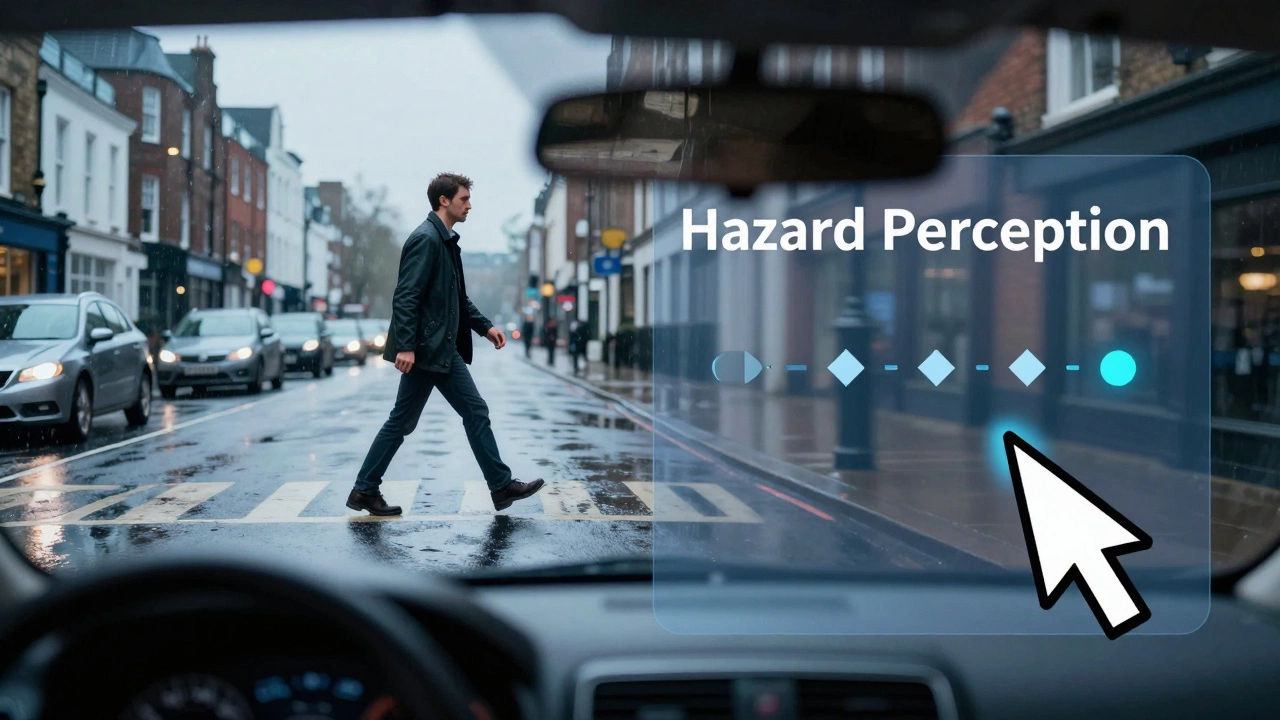
The Secret to Hazard Perception
Hazard perception is where most candidates stumble. The key is understanding the difference between a "potential hazard" and a "developing hazard." A car parked on the side of the road is a potential hazard. A car parked on the side of the road that starts to open its door is a developing hazard.
You get points for clicking when the hazard starts to develop. However, if you click too many times (spamming the screen), the computer thinks you're guessing and will give you zero points for that clip. A reliable strategy is the "three-click method." When you see a potential hazard, click once. If it continues to develop, click again a second later, and a third time shortly after. This ensures you hit the high-scoring window without triggering the spam filter.
Practice these clips until you can identify the "tell-tale" signs. For example, look for pedestrians standing near the curb looking at their phones or a gap in traffic that looks too small for a car to merge safely. These are the clues the test designers leave for you.
Building a Study Schedule that Actually Works
Cramming the night before is a recipe for disaster. Your brain needs time to move information from short-term to long-term memory. Try a 14-day sprint. Spend the first week focusing on the DVSA Theory Test Kit and the Highway Code. Spend the second week taking at least two full mock tests every day.
If you're struggling with a specific topic-say, road markings-don't just keep taking tests. Go back to the source. Look at the actual road markings in the real world while you're a passenger in a car. Ask your instructor to point out different types of lines and explain why they're there. Connecting the digital question to a real-world visual makes it almost impossible to forget.

Managing Test-Day Nerves
Panic is the enemy of a passing score. When you sit down at the computer, your heart will probably race. That's normal. The first thing you should do is take a deep breath and remember that you have plenty of time. If you hit a question that stumps you, don't waste five minutes on it. Flag it and move on. Once you've answered the easy ones, your confidence will grow, and you can go back to the flagged questions with a clearer head.
Make sure you arrive at the test center early. Stressing about a missed bus or a parking spot can drain your mental energy before you've even seen the first question. Treat the arrival as part of your warm-up. Avoid the "panic circle" of other candidates outside the test room who are stressing out about things they didn't study; it only fuels your own anxiety.
What happens if I fail one part but pass the other?
You only need to retake the part you failed. For example, if you pass the multiple-choice but fail the hazard perception, you only have to book and pay for the hazard perception part again. However, you must pass both before you can take your practical driving test.
How many clicks are too many in the hazard perception test?
There is no official "magic number," but if you click rhythmically or too rapidly (spamming), the system will disregard your scores. Using the three-click method is generally safe and effective for capturing the scoring window.
Do the actual test questions come exactly from the apps?
Most reputable apps use the official DVSA question bank, so the wording is very similar. However, the specific combination of questions and the clips used in the hazard perception test will vary. Understanding the concepts is better than memorizing specific answers.
Can I take the test on my phone?
No, the official test is taken on a computer at a certified test center. While you should study on your phone, make sure you practice on a desktop or laptop occasionally to get used to using a mouse for the hazard perception clips.
How long is the wait for a test date?
Wait times vary by region, but it's common to see slots open up several weeks or months in advance. It's best to book as soon as you start studying so you have a hard deadline to work toward.
Next Steps and Troubleshooting
If you've taken a mock test and you're consistently scoring below 80%, don't book your real test yet. You're likely missing a fundamental understanding of one or two categories. Go back to the Highway Code and read the sections on safety margins and road signs again.
For those who struggle with the hazard perception part, try recording yourself explaining the clip out loud. Say, "I see a child on the sidewalk, they might run out," and then click. Verbalizing the hazard helps your brain recognize the pattern more quickly than just clicking blindly. Once you've cleared the theory, your next move is to refine your maneuvers and road craft with your instructor to prepare for the practical exam.