
Driving Lesson Cost Estimator
Estimate Your Driving Lesson Costs
Enter your details to see a personalized estimate based on US regional pricing data
What This Estimate Includes
Save Money Tips
Plan ahead: Book during off-peak hours (weekday afternoons) for 10-15% savings.
Use your own car: Some schools allow using your vehicle with proper insurance (check state rules).
Compare providers: Prices vary significantly within the same city - get at least 3 quotes.
If you're thinking about learning to drive in the US, one of the first questions you'll ask is: how much do driving lessons cost? The answer isn't simple. Unlike countries with national pricing standards, the US has no set rate. What you pay depends on where you live, what type of lessons you take, and even the time of year.
Regional Price Differences
Driving lessons in New York City can cost nearly twice as much as those in rural Kansas. In major metro areas like Los Angeles, Chicago, or Boston, expect to pay $60 to $85 per hour. In smaller towns or Midwestern states like Iowa or Nebraska, you might find rates as low as $35 to $50 per hour. Why the gap? Urban driving schools face higher rent, insurance, and fuel costs. They also have more demand, which lets them charge more.
Some states regulate instructor pay. For example, in California, licensed driving schools must file their hourly rates with the DMV, which keeps prices somewhat consistent. In Texas, there’s no such rule-so one instructor in Houston might charge $45, while another just 20 miles away charges $75.
What’s Included in the Price?
Not all driving lessons are created equal. A $50 lesson in one school might include a brand-new car, GPS tracking, and a written progress report. Another $50 lesson might be in a 10-year-old sedan with no extra tools. Always ask what’s included before booking.
Most standard lessons cover:
- One-on-one instruction with a licensed instructor
- Use of a dual-controlled vehicle
- Basic road skills: turning, parking, merging
- Practice for the state driving test
Some schools add extras: online theory modules, mock tests, or even a free retake if you fail your road test. These can add $50 to $150 to the total cost but often save money in the long run.
Packages vs. Hour-by-Hour
Most driving schools offer two pricing models: hourly or package deals.
Hourly: Pay as you go. Good if you’re unsure about committing. But it’s usually more expensive per hour. You’ll pay $55 to $80 per session.
Package: Buy a set number of hours upfront. Common options are 5, 10, or 20 hours. A 10-hour package might cost $450 to $700-roughly $45 to $70 per hour. That’s 10-20% cheaper than paying individually. Many schools also throw in a free practice test or a post-test review.
Be careful: some packages have expiration dates. If you don’t finish within 90 days, you might lose the discount. Always read the fine print.
How Many Lessons Do You Really Need?
The average learner in the US takes between 20 and 30 hours of professional instruction before passing their road test. But that varies wildly. A 16-year-old with no prior experience might need 25 hours. A 25-year-old who’s ridden bikes and driven on private land might need only 12.
A 2025 survey by the American Driver and Traffic Safety Education Association found that students who took 15+ hours of lessons were 42% more likely to pass on their first try than those who took fewer than 5 hours. That’s a big difference. Skimping on hours might save money upfront-but cost you more in failed tests and repeat lessons.
Extra Costs to Watch For
Driving lessons aren’t the only expense. Here are other common fees:
- DMV application fee: $20 to $50, depending on the state.
- Written test fee: Usually $15 to $30.
- Road test fee: $30 to $100. Some states charge extra if you test after hours or on weekends.
- Permit fees: If you need a learner’s permit, that’s another $10 to $40.
- Practice car rental: Some schools let you rent the car for solo practice. That’s $25 to $50 per hour.
Don’t forget to budget for these. One student in Ohio paid $600 for lessons but then spent another $180 on tests and permits-nearly a third of their total cost.
Are Online Lessons Worth It?
Online theory courses (like those on DriversEd.com or Aceable) cost $20 to $60. These cover the written test material and are often required before you can get your learner’s permit. But they don’t replace behind-the-wheel training. No app can teach you how to judge distance when parallel parking or react to a sudden stop in heavy rain.
Some schools now offer hybrid models: 5 hours online + 10 hours in-car. These can cut total costs by 20-30%. But make sure the online portion is approved by your state’s DMV. Not all are.
What About Group Lessons?
Group lessons-where two or three students share one instructor-are rare in the US. Most states require one-on-one instruction for safety and licensing reasons. You won’t find group classes like you might in Europe. If someone offers it, double-check if it’s legal in your state.
How to Save Money
There are smart ways to lower costs without cutting corners:
- Ask about military, student, or senior discounts. Many schools offer 10-15% off.
- Book during off-peak hours. Lessons on weekday afternoons are often cheaper than weekend mornings.
- Use a parent or guardian as a practice driver. Most states allow supervised practice with a licensed adult. That cuts down how many paid lessons you need.
- Compare at least three schools. Prices vary even within the same city.
- Check if your high school or community college offers a driver’s ed course. These can cost as little as $100 for 30 hours of instruction.
What You Should Expect to Pay
Here’s a realistic breakdown for a typical learner in 2026:
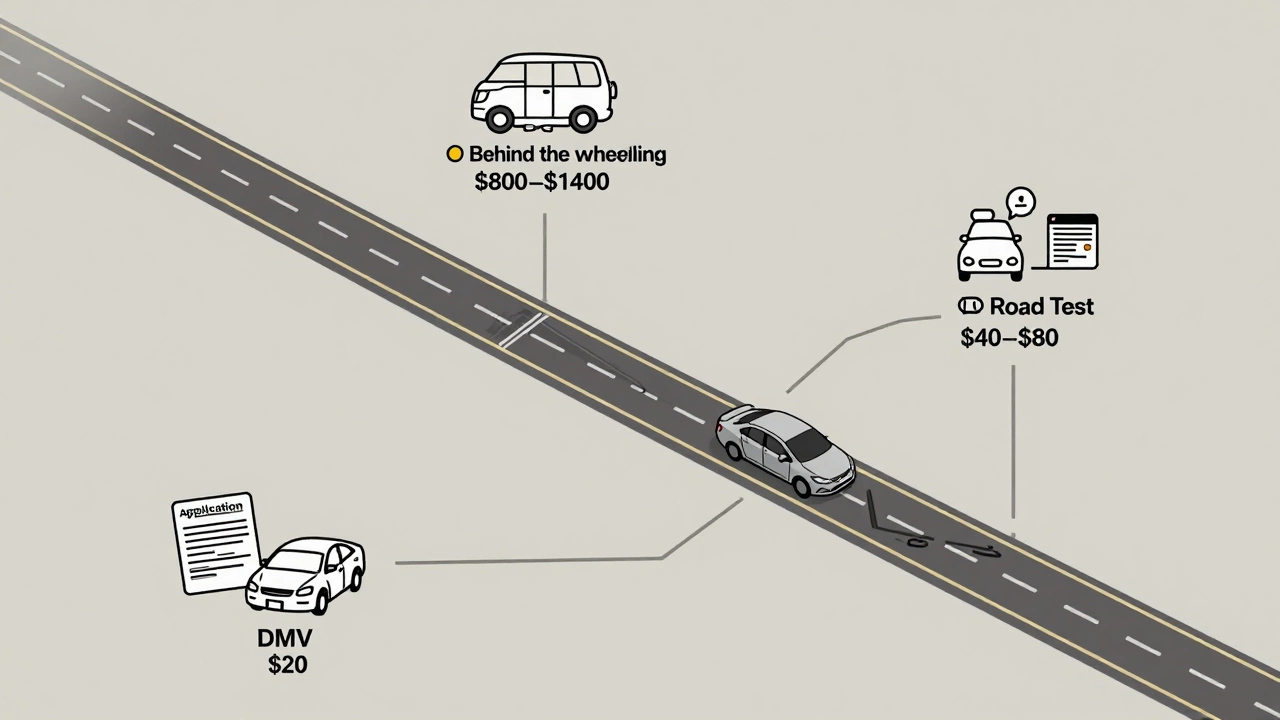
- 20 hours of driving lessons: $800-$1,400
- Written test: $20-$30
- Permit fee: $15-$40
- Road test: $40-$80
- DMV license fee: $30-$60
- Total estimated cost: $900-$1,600
That’s the full picture. It’s not cheap-but it’s an investment. The average driver in the US will spend 60+ years behind the wheel. Getting off to a solid start is worth every dollar.
Are driving lessons cheaper if I take them in winter?
Yes, in many areas, winter months (November to February) are slower for driving schools. Instructors often offer discounts to fill slots. You might save 10-15% if you book during this time. Just be aware that bad weather can delay lessons, so plan ahead.
Can I use my own car for driving lessons?
Most driving schools require you to use their vehicle. They have dual brakes, safety systems, and commercial insurance. Using your own car is usually not allowed unless you’re taking a private instructor-then it’s possible, but you’ll need proof of insurance and a vehicle that meets state safety standards.
Do I need to take a driver’s ed course before lessons?
It depends on your state. In states like New York and Florida, teens under 18 must complete a classroom driver’s ed course before getting a learner’s permit. In states like Texas and Arizona, you can skip it and go straight to behind-the-wheel lessons. Always check your state’s DMV website.
How do I know if an instructor is licensed?
All licensed driving instructors must be certified by the state’s DMV or Department of Motor Vehicles. Ask for their instructor ID number and verify it on your state’s official DMV website. Reputable schools display this info on their website. If they can’t provide it, walk away.
Is it worth paying more for a premium driving school?
Sometimes. Premium schools often use newer vehicles, have higher pass rates, and offer better support (like free retakes or test-day coaching). If you’re nervous or have learning challenges, it can be worth the extra $100-$200. But many budget schools have equally good results. Look at reviews and pass rates-not just price.